Factors Affecting Psychological Distress among Caregivers of Children with Special Needs
DOI:
https://doi.org/10.36321/kjns.vi20261.23109Keywords:
Psychological Distress, Caregivers , Children with special needs.Abstract
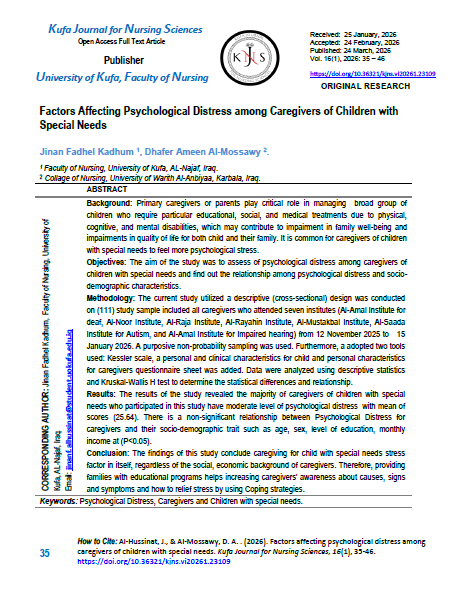
Background: Primary caregivers or parents play critical role in managing broad group of children who require particular educational, social, and medical treatments due to physical, cognitive, and mental disabilities, which may contribute to impairment in family well-being and impairments in quality of life for both child and their family. It is common for caregivers of children with special needs to feel more psychological stress.
Objectives: The aim of the study was to assess of psychological distress among caregivers of children with special needs and find out the relationship among psychological distress and socio-demographic characteristics.
Methodology: The current study utilized a descriptive (cross-sectional) design was conducted on (111) study sample included all caregivers who attended seven institutes (Al-Amal Institute for deaf, Al-Noor Institute, Al-Raja Institute, Al-Rayahin Institute, Al-Mustakbal Institute, Al-Saada Institute for Autism, and Al-Amal Institute for Impaired hearing) from 12 November 2025 to 15 January 2026. A purposive non-probability sampling was used. Furthermore, a adopted two tools used: Kessler scale, a personal and clinical characteristics for child and personal characteristics for caregivers questionnaire sheet was added. Data were analyzed using descriptive statistics and Kruskal-Wallis H test to determine the statistical differences and relationship.
Results: The results of the study revealed the majority of caregivers of children with special needs who participated in this study have moderate level of psychological distress with mean of scores (25.64). There is a non-significant relationship between Psychological Distress for caregivers and their socio-demographic trait such as age, sex, level of education, monthly income at (P<0.05).
Conclusion: The findings of this study conclude caregiving for child with special needs stress factor in itself, regardless of the social, economic background of caregivers. Therefore, providing families with educational programs helps increasing caregivers' awareness about causes, signs and symptoms and how to relief stress by using Coping strategies.
Downloads
References
Billawala, A. S., Hamza, C. A., & Stewart, S. L. (2018). Risk factors for complex special needs among male children seeking mental health services. Journal on Developmental Disabilities, 23(2), 17-26.
World Health Organization. (2018). Continuity and coordination of care: a practice brief to support implementation of the WHO Framework on integrated people-centered health services.
Babulicova, Z., & Polackova, V. (2024). Cognitive education As a Tool for the Inclusion of Students with Specific Needs. International Journal of Higher Education, 13(4), 1-51.
Olusanya, B. O., Kancherla, V., & Shaheen, A. (2022). Global and regional prevalence of disabilities among children and adolescents: Analysis of findings from global health databases. Frontiers in Public Health, 10, 977453. https://doi.org/10.3389/fpubh.2022.977453.
Ghandour, R. M., Hirai, A. H., & Kenney, M. K. (2022). Children and youth with special health care needs: a profile. Pediatrics, 149 (Supplement 7). https://doi.org/10.1542/peds.2021-053851E.
United Nations Children’s Fund (UNICEF). (2018). Iraq Multiple Indicator Cluster Survey 2018 (MICS6): Survey findings report. UNICEF Iraq.
Coleman, C. L., Morrison, M., Perkins, S. K., Brosco, J. P., & Schor, E. L. (2022). Quality of life and well-being for children and youth with special health care needs and their families: a vision for the future. Pediatrics, 149 (Supplement 7). https://doi.org/10.1542/peds.2021-053850F.
Chen, Z., Xu, X., & Tian, J. (2025). Mental Health Status of Caregivers of Children with ASD in Mainland China: The Impact of Stigma and Social Support in the Post-COVID-19 Era. Journal of Autism and Developmental Disorders, 1-14.
Findling, Y., Barnoy, S., & Itzhaki, M. (2023). Burden of treatment, emotion work and parental burnout of mothers to children with or without special needs: A pilot study. Current Psychology, 42(22), 19273-19285. https://doi.org/10.1007/s12144-022-03587-4.
Lone, A., Khan, A. S., Almaqhawi, A., & AlWadani, F. A. S. (2024). Examining the Impact of Coping Strategies on the Quality of Life in Children with Various Disabilities. Journal of Disability Research, 3(4), 20240052. https://doi.org/10.57197/JDR-2024-0052.
Ramirez, L. A., & De Leon, M. J. (2025). Parental stress and social support among caregivers of children with special needs: A study in Tagbilaran City, Bohol. Journal of Social Sciences and Humanities Research Fundamentals.
Abdulameera, A. B., & Al-Dujaili, A. H. (2022). Social stigma and psychological distress among caregivers of children with epilepsy. International Journal of Health Sciences, 6(S6), 7296-7305. https://doi.org/10.53730/ijhs.v6nS6.12044.
Machado, B. M., Dahdah, D. F., & Kebbe, L. M. (2018). Caregivers of family members with chronic diseases: coping strategies used in everyday life. Cadernos Brasileiros de Terapia Ocupacional, 26, 299-313.
Caga, J., Zoing, M. C., Foxe, D., Ramsey, E., D’Mello, M., Mioshi, E., ... & Piguet, O. (2021). Problem-focused coping underlying lower caregiver burden in ALS-FTD: implications for caregiver intervention. Amyotrophic Lateral Sclerosis and frontotemporal degeneration, 22(5-6), 434-441.
Almheiri, A. M., Alhammadi, A. S., Alzaman, K. Y., Albedwawi, M. S., Alzaabi, N. N., Alshehhi, H. M., & Haq, B. U. (2023). Maternal mental health of children with special needs. European Journal of Health Sciences, 9(2), 37–48. https://doi.org/10.47672/ejhs.1549.
Manor-Binyamini I. (2025). Bedouin fathers of children with developmental disabilities-Stress, stigma and collaboration with professionals. Research in developmental disabilities, 157, 104902. https://doi.org/10.1016/j.ridd.2024.104902.
Kokorelias, K. M., Naglie, G., Gignac, M. A., Rittenberg, N., & Cameron, J. I. (2021). A qualitative exploration of how gender and relationship shape family caregivers’ experiences across the Alzheimer’s disease trajectory. Dementia, 20(8), 2851-2866.
Thomas, S., Ryan, N. P., Byrne, L. K., Hendrieckx, C., & White, V. (2024). Psychological distress among parents of children with chronic health conditions and its association with unmet supportive care needs and children’s quality of life. Journal of Pediatric Psychology, 49(1), 45-55.
Clark, O. E., Fortney, C. A., Dunnells, Z. D., Gerhardt, C. A., & Baughcum, A. E. (2021). Parent perceptions of infant symptoms and suffering and associations with distress among bereaved parents in the NICU. Journal of Pain and Symptom Management, 62(3), e20-e27.
Videbeck, S. (2020). psychiatric-Mental Health Nursing (N. McIntyre & D. Reilly (eds.); eighth ed, Vol. 1, Issue 1). Library of Congress Cataloging-in-Publication Data.
Abdel Aziz, R. E., Ali, H. A., & Abd Elaziz, S. M. (2024). Effect of Instruction Module on Mothers' Knowledge and Coping Patterns Regarding Care of Children with Mental Retardation. Assiut Scientific Nursing Journal, 12(44), 96-108.
Samadi, S. A., McConkey, R., Nuri, H., Abdullah, A., Ahmad, L., Abdalla, B., & Biçak, C. A. (2022). Screening children for Autism Spectrum Disorders in low-and middle-income countries: Experiences from the Kurdistan region of Iraq. International Journal of Environmental Research and Public Health, 19(8), 4581. https://doi.org/10.3390/ijerph19084581.
Sanz Cortés, A. (2022). Diagnostic and Statistical Manual of Mental Disorders, Text Revision (DSM-5-TR). American Psychiatric Association, 2022. https://doi.org/10.1176/appi.books.9780890425787. Psicooncología: investigación y clínica biopsicosocial en oncología, 19(2), 339-340. https://doi.org/10.1176/appi.books.9780890425787
Esmael, A. M.,Bayoumi, H. M., & AbdElaziz, M. S. (2025). Assessment of Mothers' Knowledge and Practices toward Care of their Children with Down Syndrome. Journal of Nursing Science Benha University, 6(1), 64-80.
Downloads
Published
Issue
Section
License
Copyright (c) 2026 Jinan Al-Hussinat, Dhafer Ameen Al-Mossawy

This work is licensed under a Creative Commons Attribution 4.0 International License.
How to Cite