Isolation, Identification, and Prevalence of Bacterial Pathogens in Patients with Second and Third Degree Burns
DOI:
https://doi.org/10.36321/kjns.vi20261.22752Keywords:
burns, nosocomial infection, opportunistic bacteriaAbstract
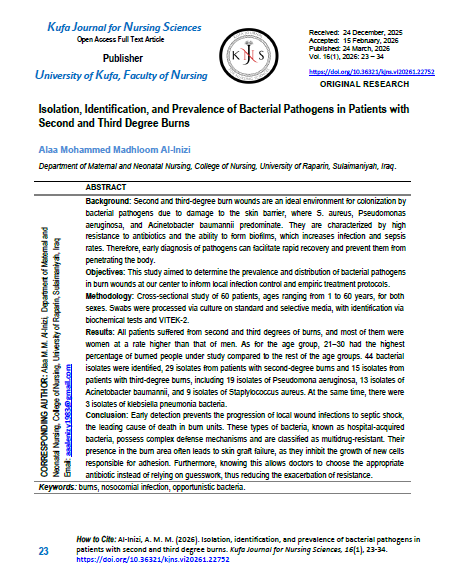
Background: Second and third-degree burn wounds are an ideal environment for colonization by bacterial pathogens due to damage to the skin barrier, where S. aureus, Pseudomonas aeruginosa, and Acinetobacter baumannii predominate. They are characterized by high resistance to antibiotics and the ability to form biofilms, which increases infection and sepsis rates. Therefore, early diagnosis of pathogens can facilitate rapid recovery and prevent them from penetrating the body.
Objectives: This study aimed to determine the prevalence and distribution of bacterial pathogens in burn wounds at our center to inform local infection control and empiric treatment protocols.
Methodology: Cross-sectional study of 60 patients, ages ranging from 1 to 60 years, for both sexes. Swabs were processed via culture on standard and selective media, with identification via biochemical tests and VITEK-2.
Results: All patients suffered from second and third degrees of burns, and most of them were women at a rate higher than that of men. As for the age group, 21–30 had the highest percentage of burned people under study compared to the rest of the age groups. 44 bacterial isolates were identified, 29 isolates from patients with second-degree burns and 15 isolates from patients with third-degree burns, including 19 isolates of Pseudomona aeruginosa, 13 isolates of Acinetobacter baumannii, and 9 isolates of Staplylococcus aureus. At the same time, there were 3 isolates of klebsiella pneumonia bacteria.
Conclusion: Early detection prevents the progression of local wound infections to septic shock, the leading cause of death in burn units. These types of bacteria, known as hospital-acquired bacteria, possess complex defense mechanisms and are classified as multidrug-resistant. Their presence in the burn area often leads to skin graft failure, as they inhibit the growth of new cells responsible for adhesion. Furthermore, knowing this allows doctors to choose the appropriate antibiotic instead of relying on guesswork, thus reducing the exacerbation of resistance.
Downloads
Downloads
Published
Issue
Section
License
Copyright (c) 2026 Alaa Mohammed Madhloom Al-Inizi

This work is licensed under a Creative Commons Attribution 4.0 International License.
How to Cite