Efficacy of Nurse-Supervised Structured Progressive Exercise Program on Muscle Force Outcomes among Rheumatoid Arthritis Patients
DOI:
https://doi.org/10.36321/kjns.vi20262.24377Keywords:
Progressive Exercise Program, Muscle ForceAbstract
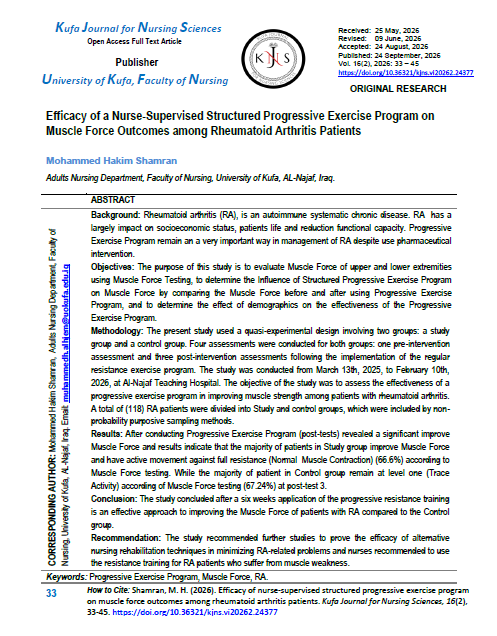
Background: Rheumatoid arthritis (RA), is an autoimuune systematic chronic disease. RA has a largly impact on socioeconomic status, patients life and reduction functional capacity. Progressive Exercise Program remain an a very impotant way in management of RA despite use pharmaceutical intervention.
Methods: The present study used a quasi-experimental design involving two groups: a study group and a control group. Four assessments were conducted for both groups: one pre-intervention assessment and three post-intervention assessments following the implementation of the regular resistance exercise program. The study was conducted from March 13th, 2025, to February 10th, 2026, at Al-Najaf Teaching Hospital. The objective of the study was to assess the effectiveness of a progressive exercise program in improving muscle strength among patients with rheumatoid arthritis. A total of (118) RA patients were divided into Study and control groups, which were included by non-probability purposive sampling methods.
Results: After conducting Progressive Exercise Program (post-tests) revealed a significant improve Muscle Force and results indicate that the majority of patients in Study group improve Muscle Force and have active movement against full resistance (Normal Muscle Contraction) (66.6%) according to Muscle Force testing. While the majority of patient in Control group remain at level one (Trace Activity) according of Muscle Force testing (67.24%) at post-test 3.
Conclusion: the study concluded after a six weeks application of the progressive resistance training is an effective approach to improving the Muscle Force of patients with RA compared to the Control group.
Recommendations: The study recommended further studies to prove the efficacy of alternative nursing rehabilitation techniques in minimizing RA-related problems and nurses recommended to use the resistance training for RA patients who suffer from muscle weakness.
Downloads
References
1. Cooney, J. K., Law, R. J., Matschke, V., Lemmey, A. B., Moore, J. P., Ahmad, Y., ... & Thom, J. M. (2011). Benefits of exercise in rheumatoid arthritis. Journal of aging research, 2011(1), 681640.
2. Jønsson, A. B., Johansen, C. V., Rolving, N., & Pfeiffer-Jensen, M. (2021). Feasibility and estimated efficacy of blood flow restricted training in female patients with rheumatoid arthritis: a randomized controlled pilot study. Scandinavian journal of rheumatology, 50(3), 169-177.
3. Häkkinen, A., Sokka, T., Kotaniemi, A., & Hannonen, P. (2001). A randomized two‐year study of the effects of dynamic strength training on Muscle Strength, disease activity, functional capacity, and bone mineral density in early rheumatoid arthritis. Arthritis & Rheumatism, 44(3), 515-522.
4. Lourenzi, F. M., Jones, A., Pereira, D. F., Santos, J. H. C. A. D., Furtado, R. N. V., & Natour, J. (2017). Effectiveness of an overall progressive resistance strength program for improving the functional capacity of patients with rheumatoid arthritis: a randomized controlled trial. Clinical rehabilitation, 31(11), 1482-1491.
5. Larsson, A., Palstam, A., Löfgren, M., Ernberg, M., Bjersing, J., Bileviciute-Ljungar, I., ... & Mannerkorpi, K. (2015). Resistance exercise improves Muscle Strength, health status and pain intensity in fibromyalgia—a randomized controlled trial. Arthritis research & therapy, 17(1), 161.
6. Hurkmans, E., van der Giesen, F. J., Vlieland, T. P. V., Schoones, J., & Van den Ende, E. C. (2009). Dynamic exercise programs (aerobic capacity and/or Muscle Strength training) in patients with rheumatoid arthritis. Cochrane Database of Systematic Reviews, (4).
7. Baillet, A., Vaillant, M., Guinot, M., Juvin, R., & Gaudin, P. (2012). Efficacy of resistance exercises in rheumatoid arthritis: meta-analysis of randomized controlled trials. Rheumatology, 51(3), 519-527.
8. Boniface, G. (2024). Exploring strength exercise prescription and its dose in rheumatoid arthritis (Doctoral dissertation, Brunel University London).
9. Al-Hchaim, M. H. S., & Mohammed, S. S. (2023). Effectiveness of Regular Resistance Exercise on Muscle Strength of Patients with Stroke. HIV Nursing, 23(3), 388-396.
10. Messier, S. P., Mihalko, S. L., Beavers, D. P., Nicklas, B. J., DeVita, P., Carr, J. J., ... & Loeser, R. F. (2013). Strength Training for Arthritis Trial (START): design and rationale. BMC musculoskeletal disorders, 14(1), 208.
11. Silva, D. R., Meireles, S. M., Brumini, C., & Natour, J. (2023). Effectiveness of functional training versus resistance exercise in patients with psoriatic arthritis: randomized controlled trial. Advances in Rheumatology, 63(1), 58.
12. Al-Hchaim, M. H., Abdullah, A. M. ., & Abd Ali, D. K. . (2022). Relationship Between Exercise Training and Quality of Life in Heart Failure Patients. Al-Rafidain Journal of Medical Sciences ( ISSN 2789-3219 ), 2, 115–121. https://doi.org/10.54133/ajms.v2i.73.
13. Asadzadeh, A., Samad-Soltani, T., Salahzadeh, Z., & Rezaei-Hachesu, P. (2021). Effectiveness of virtual reality-based exercise therapy in rehabilitation: A scoping review. Informatics in Medicine Unlocked, 24, 100562.
14. Black, R. J., Cross, M., Haile, L. M., Culbreth, G. T., Steinmetz, J. D., Hagins, H., ... & Majeed, A. (2023). Global, regional, and national burden of rheumatoid arthritis, 1990–2020, and projections to 2050: a systematic analysis of the Global Burden of Disease Study 2021. The Lancet Rheumatology, 5(10), e594-e610
Downloads
Published
Issue
Section
License
Copyright (c) 2026 Mohammed Hakim Shamran

This work is licensed under a Creative Commons Attribution 4.0 International License.
How to Cite