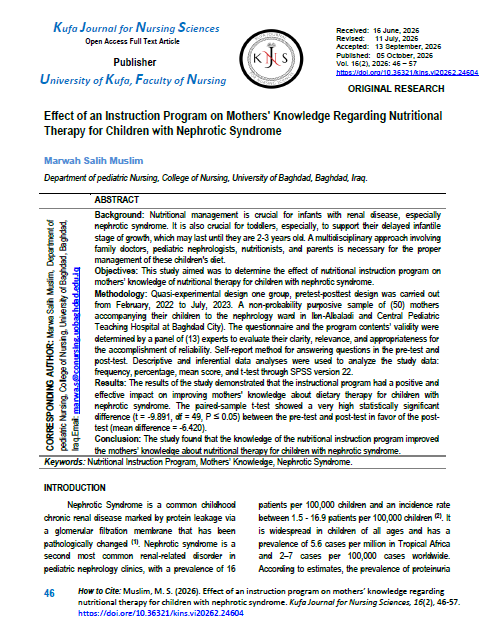
Effect of an Instruction Program on Mothers' Knowledge Regarding Nutritional Therapy for Children with Nephrotic Syndrome
DOI:
https://doi.org/10.36321/kjns.vi20262.24604Keywords:
Nutritional Instruction Program, Mothers’ Knowledge, Nephrotic Syndrome.Abstract
Background: Nutritional management is crucial for infants with renal disease, especially nephrotic syndrome. It is also crucial for toddlers, especially, to support their delayed infantile stage of growth, which may last until they are 2-3 years old. A multidisciplinary approach involving family doctors, pediatric nephrologists, nutritionists, and parents is necessary for the proper management of these children's diet.
Objectives: This study aimed was to determine the effect of nutritional instruction program on mothers’ knowledge of nutritional therapy for children with nephrotic syndrome.
Methodology: Quasi-experimental design one group, pretest-posttest design was carried out from February, 2022 to July, 2023. A non-probability purposive sample of (50) mothers accompanying their children to the nephrology ward in Ibn-Albaladi and Central Pediatric Teaching Hospital at Baghdad City). The questionnaire and the program contents’ validity were determined by a panel of (13) experts to evaluate their clarity, relevance, and appropriateness for the accomplishment of reliability. Self-report method for answering questions in the pre-test and post-test. Descriptive and inferential data analyses were used to analyze the study data: frequency, percentage, mean score, and t-test through SPSS version 22.
Results: The results of the study demonstrated that the instructional program had a positive and effective impact on improving mothers' knowledge about dietary therapy for children with nephrotic syndrome. The paired-sample t-test showed a very high statistically significant difference (t = -9.891, df = 49, P ≤ 0.05) between the pre-test and post-test in favor of the post-test (mean difference = -6.420).
Conclusion: The study found that the knowledge of the nutritional instruction program improved the mothers’ knowledge about nutritional therapy for children with nephrotic syndrome.
Downloads
References
1. Khanna A, Kharkongor NP, Verma A, Bhalla K, Gill PS, Verma S et al. Prevalence of Allergies in Children with Idiopathic Nephrotic Syndrome. Medical Journal of Dr. D.Y.PatilVidyapeeth.2024Oct1;17:S121-S125. doi:10.4103/mjdrdypu.mjdrdypu_124_24
2. Yu X, Han CY. Effect assessment of evidence-based nursing in combination with clinical nursing pathway on nephrotic syndrome care in children: A protocol for systematic review and meta-analysis. Medicine. 2021;100(22):e25990. https://doi.org/10.1097/MD.0000000000025990.
3. Nalubega R, Batte A, Kiguli S. Prevalence and predictors of stunting in children and adolescents aged 1-18 years with nephrotic syndrome attending Mulago Hospital, Uganda. BMC Nephrol. 2025 Mar 3;26(1):110. doi:10.1186/s12882-025-04025-2. PMID: 40033302; PMCID: PMC11877718.
4. Mekonnen BA, Alene TD, Yimer YA, Lakew AM, Genet GB. Prevalence and associated factors of infection in children with nephrotic syndrome aged 2-18 years in the northwest and east Amhara region, Ethiopia: a multi-center cross-sectional retrospective study. BMC Public Health. 2024 Jul 10;24(1):1845. doi:10.1186/s12889-024-19408-7. PMID: 38987746; PMCID: PMC11238409.
5. fotoohi ahmad. Nutrition in Pediatric Nephrotic Syndrome. Journal of pediatric nephrology. 2017,5, 1-3.
6. Frățilă VG, Lupușoru G, Sorohan BM, Obrișcă B, Mocanu V, Lupușoru M, Ismail G. Nephrotic Syndrome: From Pathophysiology to Novel Therapeutic Approaches. Biomedicines. 2024 Mar 3;12(3):569. doi:10.3390/biomedicines12030569. PMID: 38540182; PMCID: PMC10968602.
7. Shaker AT, Ali SH, Ali LQ. Hospitalization of children with nephrotic syndrome. Iraqi. Med. Sci. 2024;22(1).
8. Alsaiary KR, Almutairi AK, Al-Hasnah SA, Alharbi SS, et al. Assessment of children with nephrotic syndrome at pediatric hospitals. J Surv Fish Sci. 2023;10(6). doi:10.53555/sfs. v10i6.2294
9. Tiwari V, Pandey P. Nutrition in pediatric nephrotic syndrome. Int J Ther Innov. 2023;1(3):68-74.
10. Lella G, Pecoraro L, Benetti E, Arnone OC, Piacentini G, Brugnara M, Pietrobelli A. Nutritional Management of Idiopathic Nephrotic Syndrome in Pediatric Age. Med Sci (Basel). 2023 Jul 28;11(3):47. doi: 10.3390/medsci11030047. PMID: 37606426; PMCID: PMC10443265.
11. Downie ML, Gallibois C, Parekh RS, Noone DG. Nephrotic syndrome in infants and children: pathophysiology and management. Paediatr Int. Child Health. 2017 Nov;37(4):248-258. doi: 10.1080/20469047.2017.1374003. Epub 2017 Sep 15. PMID: 28914167.
12. Negi S, Chauhan V, Devi RJ. Effectiveness of "Need Based Education on Homecare of Nephrotic Syndrome" on Knowledge and Practice among Care Givers of Children with Nephrotic Syndrome. Int J Health Sci Res. 2020; 10(12): 275-279.
13. Husain HM, Ragheb SG, Mikky SF. Mother’s Care for Children with Nephritic Syndrome at Home. Tanta Sci Nurs J. 2018; 15(2): 173-194.
14. Diong SC, Syed Zakaria SZ, Rasat R, Wan Ismail WJ. Parental Knowledge on Nephrotic Syndrome and Disease Relapse in children. Med J Malaysia. 2019 Aug;74(4):288-295. PMID: 31424035.
15. Li N, Hao J, Fu T, Du Y. Evaluating the Quality of Life of 231 Children With Primary Nephrotic Syndrome and Assessing Parental Awareness of the Disease. Front Pediatr. 2021 Dec 2; 9:745444. doi:10.3389/fped.2021.745444. PMID: 34926339; PMCID: PMC8674756.
16. Nagat F. Abolwafa and Yosria El-Sayed Hossein. Effect of Educational Program on Knowledge and Health Care Practices about Nephrotic Syndrome among Mothers of Pre-School Children. American Journal of Nursing Research. 2018; 6(5):244-252. doi:10.12691/ajnr-6-5-5
17. Herien N, Allenidekania A, Waluyanti FT. Mothers' experiences in caring for children with nephrotic syndrome relapse. Enfermería Clínica. 2020; 30(Suppl 3): 71–74.
18. Hark L, Ashton K, Deen D, editors. The nurse practitioner's guide to nutrition. 2nd ed. Chichester: John Wiley & Sons; 2012.
19. Ali AI, Al-Mosawi KM. Mothers quality of life towards their children with nephrotic syndrome at pediatric teaching hospitals in Baghdad city. Indian J Forensic Med Toxicol. 2021; 15(3): 1083-1088.
20. Al-azzawy, M. F., Al-Haggar, M., ElSaid, A. M., El-khawaga, O. Y. Association between NPHS1 and NPHS2 genes polymorphism and Risk of the primary nephrotic syndrome among Egyptian Populations. Egyptian Journal of Chemistry, 2022; 65(132): 959-968. doi: 10.21608/ejchem.2022.155705.6725
21. Caparali EB, De Gregorio V, Barua M. Genetic Causes of Nephrotic Syndrome and Focal and Segmental Glomerulosclerosis. Adv Kidney Dis Health. 2024 Jul;31(4):309-316. doi: 10.1053/j.akdh.2024.04.001. PMID: 39084756.
22. Alamelu M, Sophia J. Evaluating the effect of structured teaching programme on nephrotic syndrome in children in terms of knowledge and attitude among mothers attending a selected hospitals at Madurai in Tamilnadu, India. The Genesis. 2019; 6(2): 1-5.
23. Singh DN, Bohra JS, Dubey TP, Shivahre PR, Singh RK, Singh T, Jaiswal DK. Common foods for boosting human immunity: A review. Food Sci Nutr. 2023 Aug 18;11(11):6761-6774. doi: 10.1002/fsn3.3628. PMID: 37970422; PMCID: PMC10630845.
24. El-Saadony MT, Saad AM, Korma SA, Salem HM, Abd El-Mageed TA, Alkafaas SS, Elsalahaty MI, Elkafas SS, Mosa WFA, Ahmed AE, Mathew BT, Albastaki NA, Alkuwaiti AA, El-Tarabily MK, AbuQamar SF, El-Tarabily KA, Ibrahim SA. Garlic bioactive substances and their therapeutic applications for improving human health: a comprehensive review. Front Immunol. 2024 Jun 10;15:1277074. doi:10.3389/fimmu.2024.1277074. PMID: 38915405; PMCID: PMC11194342.
25. Martínez B. & Liñán M, Nutrition for Hypercholesterolemic Children, Journal of Child Science, 2018; 8(1): 106-112.
26. Slavin J & Lloyd B, Health Benefits of Fruits and Vegetables, American Society for Nutrition. Advnce. Nutrition, 2012; 3(1): 506-515.
27. Lindeback R et al., Does the Nutritional Intake and Diet Quality of Children with Chronic Kidney Disease Differ from Healthy Controls? A Comprehensive Evaluation, Journal of Renal Nutrition, 2024;34(4):283-293
28. Yousefichaijan P et al., Vitamin D Status in Children with Nephrotic Syndrome, Journal of Comprehensive Pediatrics, 2018;9(3): e12403.
29. Elsayed E. Effect of Implementation of Teaching Program about Care of Children with Nephrotic Syndrome on Nurses Knowledge and Practice. Tanta Scientific Nursing Journal. doi:10.21608/TSNJ.2017.69214
30. Hassan A et al., Impact of an Educational Program on Parents' Knowledge, Attitude and Practice Towards Pediatric Nephrotic Syndrome, The Journal of the Egyptian Society of Pediatric Nephrology & Translatation, 2024; 19(2):2636-3666.
31. Elangbam Aruna Devi, Dr. Sneha Pitre And Bhagyashree Jogdeo. A pre experimental study to assess the effectiveness of information booklet on knowledge among care givers regarding care of child with nephrotic syndrome in selected hospitals of Pune City. Int J Appl Res 2017;3(7):610-615.
Downloads
Published
Issue
Section
License
Copyright (c) 2026 Marwah Salih Muslim

This work is licensed under a Creative Commons Attribution 4.0 International License.
How to Cite